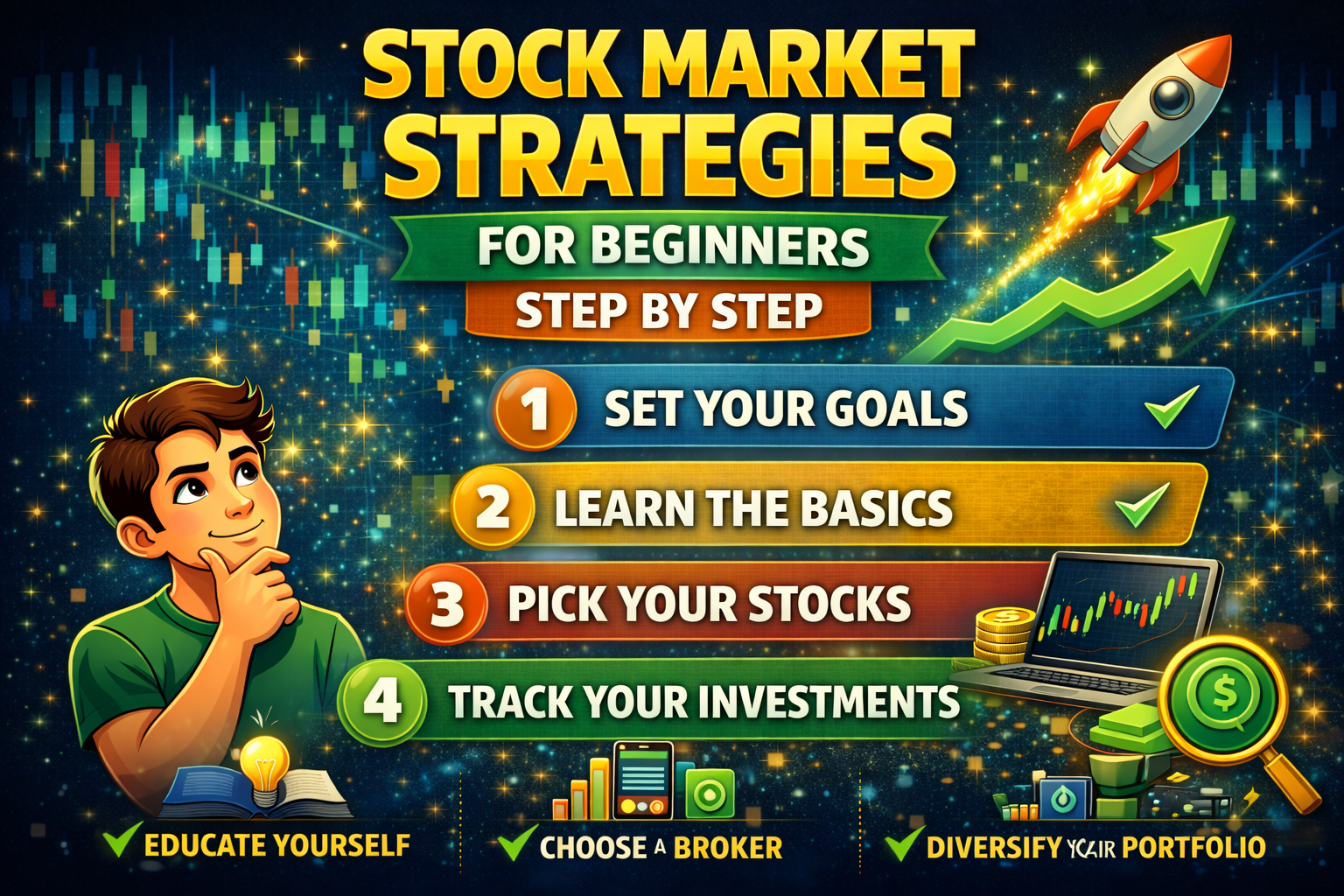
You’ve heard the phrase “buy low, sell high” about a thousand times.
But nobody ever explains how to actually do that. What does “low” even mean? When do you sell? Do you buy everything at once? Do you wait for a crash?
I remember staring at my first brokerage account with $500 in it, completely frozen. I had the money. I had the motivation. But I had zero strategy. So I did nothing. And I lost three months of potential growth just because I was afraid of making the wrong move.
That’s why I wrote this guide. Below is a step-by-step strategy for beginner stock market investors. No complicated jargon. No get-rich-quick nonsense. Just a repeatable system that works.
Before Step 1: The Mindset Shift (Read This First)
Most beginners think investing strategy is about picking the right stocks. It’s not.
The real strategy is about behavior. Can you buy when everyone else is panicking? Can you do nothing when everyone else is gambling on meme stocks? Can you stick to a boring plan for ten years?
If the answer is yes, you’re already ahead of 90% of investors. If the answer is no, these steps will help train that muscle.
Step 1: Decide Your “Investor Personality” (5 Minutes)
There is no single best strategy. There is only the strategy you will actually stick with.
Choose your lane below:
| Personality | Description | Best Strategy |
|---|---|---|
| The Set & Forget | You hate checking your phone. You want minimal effort. | Automated index fund investing |
| The Active Learner | You enjoy research but have a full-time job. | Core & satellite portfolio |
| The Income Seeker | You want cash flow, not just growth. | Dividend investing |
| The Bargain Hunter | You love sales and buying things on discount. | Value averaging / dip buying |
Not sure? Pick “The Set & Forget.” It works for 80% of people. You can always change later.
Step 2: Fund Your Account (But Don’t Buy Anything Yet)
Open a brokerage account if you haven’t already. (Fidelity, Vanguard, or Schwab. Take your pick.)
Transfer your first chunk of money. For this step-by-step, let’s assume $1,000.
Here’s the trick: Do not buy anything for 48 hours. Just let the money sit there. This prevents impulse buying. The market will still be there on Wednesday.
Step 3: Choose Your Strategy’s “Engine” (The Core Holding)
Every good beginner strategy starts with a foundation. This is the thing you put most of your money into so you don’t blow yourself up.
For The Set & Forget: Buy an S&P 500 index fund (VOO, IVV, or SWPPX). Put 100% of your money here until you hit $10,000.
For The Active Learner: Buy 80% in an S&P 500 fund. Keep 20% in cash to buy individual stocks later.
For The Income Seeker: Buy a dividend ETF like SCHD or VYM. These pay you cash every three months.
For The Bargain Hunter: Buy 50% in an S&P 500 fund. Keep 50% in cash to deploy during market dips.
Action step right now: Log into your brokerage. Search for VOO. Buy $800 worth (if you’re using the $1,000 example). Leave $200 aside.
Step 4: Set Up Your “Rhythm” (This Beats Timing the Market)
The single biggest mistake beginners make is trying to time their buys. They wait for a “good day.” Then the market goes up. Then they wait for a dip. Then it goes up more. Then they buy at the top out of frustration.
The fix: Dollar Cost Averaging (DCA).
Here’s how to set it up in under 5 minutes:
- In your brokerage account, look for “Automatic Investments” or “Recurring Transfers.”
- Set up an auto-transfer of $50 every Friday from your bank account.
- Set up an auto-investment of that $50 into VOO (or your chosen fund).
That’s it. You now buy whether the market is up, down, or sideways. Over time, you automatically buy more shares when prices are low and fewer when prices are high. It’s mathematically boring. It works.
Step 5: The “What to Do on a Red Day” Playbook (Most Important Step)
The market will drop. It always does. And when it happens, your brain will scream at you to sell.
Here is your exact playbook for a red day (when the market drops 2% or more):
| Drop Amount | What a Beginner Does | What You Will Do |
|---|---|---|
| 2-5% | Panics, checks phone 20 times | Do nothing. Your auto-invest is still running. |
| 5-10% | Considers selling | Check your cash reserve. Buy a little extra if you have it. |
| 10-20% | Sells everything (the worst move) | Increase your auto-invest amount if you can. |
| 20%+ | Swears off stocks forever | This is a once-a-decade sale. Buy aggressively. |
Write this down on a sticky note: “I will not sell during a crash. I will buy more or do nothing.” Put it on your monitor.
Step 6: When to Sell (Yes, Eventually You Must Sell)
Most beginner guides tell you how to buy. Nobody tells you when to sell.
Here is a simple selling framework for beginners:
Sell only for these three reasons:
- You need the money. (Buying a house, paying for college, retiring. This is a good reason.)
- Your strategy has changed. (You were aggressive at 25. Now you’re 55 and need bonds. That’s fine.)
- You made a specific profit target. (Example: “I will sell 50% of this stock if it doubles.”)
Do NOT sell for these reasons:
- The news is scary.
- Your friend sold.
- You feel nervous.
- The market dropped for three days in a row.
If you sell during a panic, you turn a temporary loss into a permanent one.
Step 7: The Quarterly Check-In (15 Minutes Every 3 Months)
You don’t need to watch the market daily. In fact, you shouldn’t. But you should check in once per quarter.
Open your brokerage account on the first Sunday of January, April, July, and October. Do this three-step review:
Step A: Rebalance
If your target was 80% stocks / 20% bonds, but stocks grew to 90%, sell some stocks and buy bonds to get back to 80/20. This forces you to “sell high” automatically.
Step B: Increase Your Contribution
Did you get a raise? Can you add $10 more per week? Small increases now become huge later.
Step C: Check Your Fees
You should never pay more than 0.10% in fees for an index fund. If you’re paying 1% for a “managed” fund, move your money. That 1% eats 30% of your returns over 30 years.
A Real-World Example: Putting It All Together
Let me show you how this works with a real person named Sarah.
- Sarah is 28. She has $2,000 to start.
- Personality: Set & Forget.
- Step 1: She picks the S&P 500 strategy.
- Step 2: She opens a Fidelity account.
- Step 3: She buys $1,600 of FXAIX (Fidelity’s S&P fund). Keeps $400 in cash.
- Step 4: She sets up $75 automatic investment every Monday.
- Step 5: Three months later, the market drops 8%. She does nothing. Her auto-invest buys cheaper shares.
- Step 6: One year later, she’s up 12%. She doesn’t sell. She keeps going.
- Step 7: Five years later, she has $28,000. She’s never sold a single share.
Sarah is not a genius. Sarah is not lucky. Sarah just followed the steps and didn’t panic.
The Most Common Beginner Strategy Mistakes (And How to Fix Them)
| Mistake | Why It Happens | The Fix |
|---|---|---|
| Checking prices daily | Anxiety disguised as diligence | Delete the app. Use the website once a month. |
| Buying “dip” too aggressively | FOMO on a sale | Keep a fixed cash percentage (10-20%). Never go below it. |
| Selling after a 10% drop | Recency bias (thinking the drop will continue) | Re-read your sticky note. Do nothing for 30 days. |
| Following YouTubers’ stock picks | Desire for shortcuts | Unsubscribe. Boring strategies outperform hot tips. |
| Not starting because $50 feels “too small” | Perfectionism | $50 today beats $500 next year. Always. |
Your 30-Day Beginner Strategy Challenge
Ready to stop reading and start doing? Here is your exact 30-day plan:
- Week 1: Open a brokerage account. Transfer $100.
- Week 2: Buy $80 of VOO. Leave $20 in cash.
- Week 3: Set up auto-invest for $25 weekly.
- Week 4: Do not open the app. Read a book about investing instead (try The Little Book of Common Sense Investing by John Bogle).
- Day 31: Check your balance. Resist the urge to sell. Increase your auto-invest by $5.
Do this for 12 months. Then come back and thank yourself.
The Bottom Line (Read This Last)
Stock market strategies for beginners come down to exactly five things:
- Pick one boring strategy (index funds are perfect).
- Automate your buys (remove your own emotions).
- Ignore the news (it is designed to make you panic).
- Never sell during a crash (that’s when the rich get richer).
- Increase your contribution over time (even $5 more per week matters).
That’s it. That’s the whole “secret.” Wall Street hates how simple this is because they can’t charge you for it.
You now have a step-by-step strategy. The only thing left is to take the first step.
Your move: Open that brokerage tab right now. Don’t wait for Monday. Don’t wait for the perfect market conditions. Just start.
Disclaimer: This is for educational purposes only and does not constitute financial advice. All investing involves risk, including the possible loss of principal. Past performance does not guarantee future results. Consult a qualified financial professional before making investment decisions.