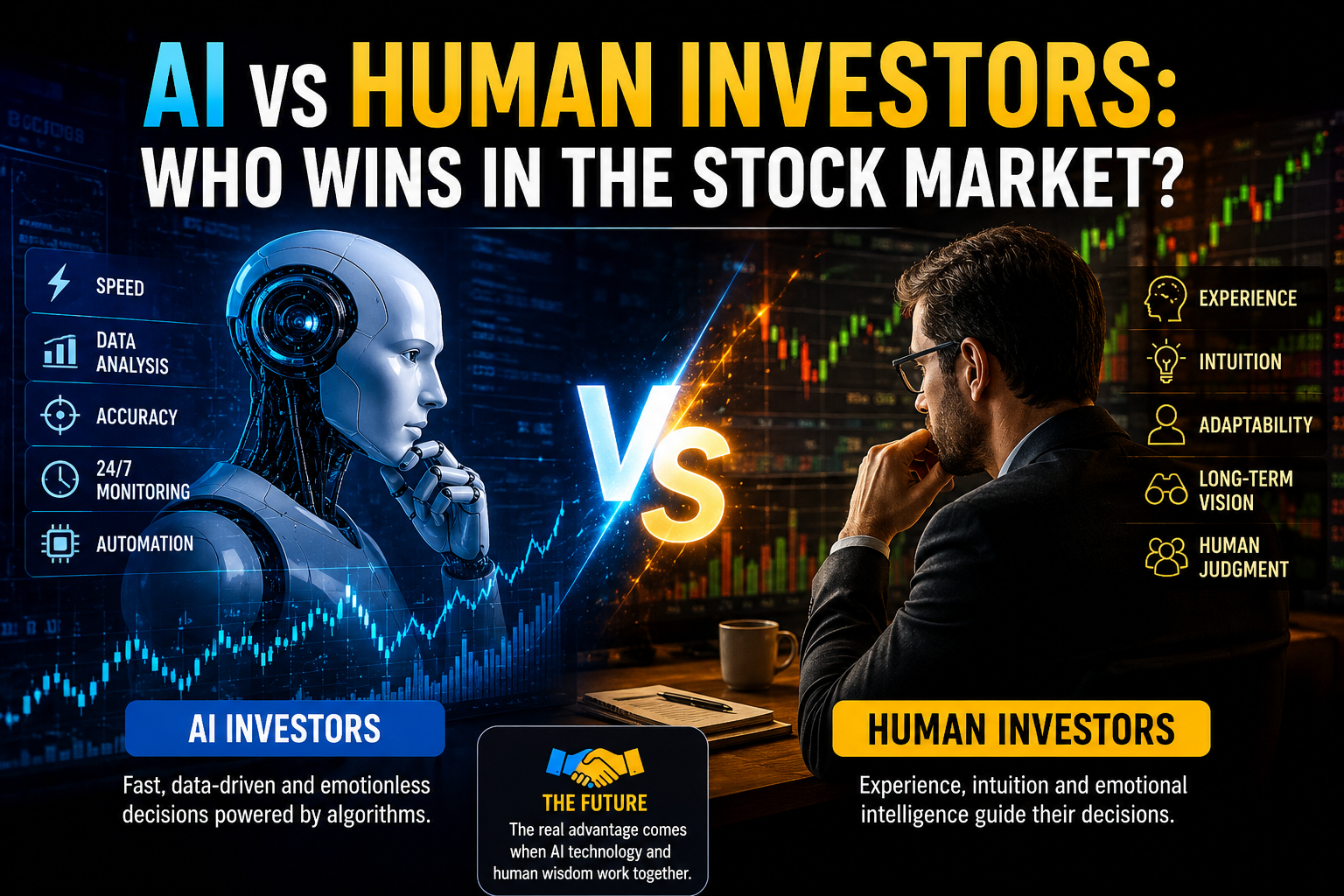
The stock market has always been a battlefield of intelligence, strategy, patience, and timing. For decades, human investors dominated the financial world using experience, research, and instinct to make investment decisions. But in recent years, artificial intelligence has entered the market with incredible speed and accuracy, changing the way investing works forever.
Today, AI-powered trading systems can analyze millions of data points in seconds, predict trends, and even execute trades automatically. This raises an important question: can AI outperform human investors in the long run, or does human judgment still have the upper hand?
The answer is more complex than many people think. Both AI and human investors have unique strengths and weaknesses, and understanding these differences can help investors make smarter decisions in the future.
The Rise of AI in the Stock Market
Artificial intelligence is no longer a futuristic concept. It is already deeply integrated into modern financial markets. Hedge funds, investment banks, and trading firms use AI systems to analyze stock prices, financial reports, news headlines, and even social media sentiment.
AI can process massive amounts of information far faster than any human. While a person may take hours to study one company, AI systems can scan thousands of stocks in seconds.
Machine learning algorithms continuously improve by analyzing historical market data. Over time, they identify patterns that humans may never notice.
This technological advantage has made AI an important tool in modern investing.
How AI Investors Work
AI investing systems rely on data and algorithms. They do not make decisions based on emotions or personal opinions.
These systems collect information from various sources, including:
- Stock price movements
- Trading volume
- Economic reports
- Company earnings
- Market news
- Social media trends
- Global events
The AI then uses mathematical models to predict future price movements or identify trading opportunities.
Some AI systems are designed for short-term trading, while others focus on long-term investment strategies.
Advantages of AI Investors
1. Speed and Efficiency
One of the biggest strengths of AI is speed. Financial markets move extremely fast, and opportunities can disappear within seconds.
AI systems can instantly react to breaking news or sudden price changes without hesitation.
Human investors simply cannot compete with this level of speed.
2. No Emotional Decisions
Human emotions are one of the biggest reasons investors lose money.
Fear causes panic selling during market crashes, while greed often leads to risky investments during market booms.
AI does not feel fear, excitement, or stress. It follows logic and data-driven strategies consistently.
This emotional discipline can reduce costly mistakes.
3. Ability to Analyze Massive Data
AI can analyze millions of pieces of information simultaneously.
A human investor may struggle to track hundreds of companies, but AI can monitor entire markets in real time.
This allows AI systems to identify hidden opportunities and market trends much faster.
4. 24/7 Monitoring
Global markets never truly sleep. News from one country can impact stocks worldwide within minutes.
AI systems can monitor markets around the clock without getting tired.
This constant attention gives AI a major advantage in fast-moving environments.
Weaknesses of AI Investors
Despite its power, AI is not perfect.
1. Lack of Human Judgment
AI relies heavily on historical data and patterns. However, markets are influenced by unpredictable events such as wars, political changes, or economic crises.
Humans can sometimes understand these situations better through intuition and real-world experience.
AI may struggle when facing events it has never seen before.
2. Overdependence on Data
AI systems are only as good as the data they receive.
Incorrect, biased, or incomplete data can lead to poor investment decisions.
If the market behaves differently from historical patterns, AI models may fail.
3. Flash Crashes and Market Risks
Automated trading systems can sometimes create sudden market crashes.
When many AI systems react to the same signals at once, massive sell-offs can happen within seconds.
This can increase market volatility and unpredictability.
The Strength of Human Investors
Even with advanced technology, human investors still play a major role in financial markets.
Legendary investors like Warren Buffett built enormous wealth long before AI became popular.
Human investors bring creativity, patience, and emotional understanding to investing.
Advantages of Human Investors
1. Critical Thinking
Humans can evaluate situations beyond numbers and charts.
For example, an experienced investor may understand cultural trends, consumer behavior, or leadership quality better than an AI system.
These insights can be extremely valuable in long-term investing.
2. Flexibility
Markets constantly evolve.
Humans can adapt strategies quickly when conditions change unexpectedly.
AI systems often require retraining or updated data to adjust properly.
3. Long-Term Vision
Many successful human investors focus on business quality rather than short-term price movements.
They invest in companies they believe will grow over decades.
AI trading systems often prioritize short-term profits instead of long-term value creation.
Weaknesses of Human Investors
Humans also have serious disadvantages.
Emotional Mistakes
Fear and greed frequently lead to poor decisions.
Many investors panic during market crashes and buy excessively during market bubbles.
These emotional reactions can destroy long-term returns.
Limited Processing Ability
Humans cannot process information as quickly as AI systems.
Researching multiple industries and global events takes significant time and effort.
This limits the speed of decision-making.
Bias and Overconfidence
Human investors often become emotionally attached to stocks or believe they can predict markets better than they actually can.
This overconfidence can result in heavy financial losses.
Who Performs Better?
The answer depends on the type of investing.
Short-Term Trading
In high-frequency and short-term trading, AI usually has the advantage.
The speed, accuracy, and automation of AI systems make them extremely effective in fast-moving markets.
Large financial institutions already rely heavily on AI for this reason.
Long-Term Investing
For long-term investing, humans still compete very well.
Successful investors often focus on patience, business fundamentals, and long-term trends rather than short-term price movements.
These qualities are harder for AI systems to replicate completely.
The Future: Humans and AI Working Together
The future of investing may not be a battle between AI and humans. Instead, the best results could come from combining both.
Many investors now use AI tools to support research and market analysis while still relying on human judgment for final decisions.
This hybrid approach allows investors to benefit from technology without losing human insight and creativity.
Financial advisors, hedge funds, and even individual investors increasingly use AI-powered tools for portfolio management and stock screening.
As technology continues to evolve, AI will likely become even more powerful in the investment world.
Final Thoughts
Artificial intelligence has transformed the stock market and changed how investing works forever. AI offers incredible speed, data analysis, and emotional discipline, making it highly effective in many areas of trading.
However, human investors still possess qualities that machines cannot fully replace, including intuition, creativity, flexibility, and long-term vision.
Rather than replacing humans completely, AI is becoming a powerful partner in the investment process.
In the end, the real winners may not be AI or humans alone, but investors who learn how to use both together effectively.